The Metal Trees
Part 4 of 4 in the Silver Mirror Toning series | ← Previous: Part 3
There are eighteen of them at Gardens by the Bay — steel armatures between twenty-five and fifty metres high, planted with bromeliads and ferns and flowering climbers, fitted with photovoltaic cells and rainwater collection. They are called Supertrees. They are not trees. They are infrastructure wearing a hundred and sixty thousand plants, and from a distance the illusion holds completely; up close it collapses into welded steel and irrigation, and then, if you keep looking, reassembles.
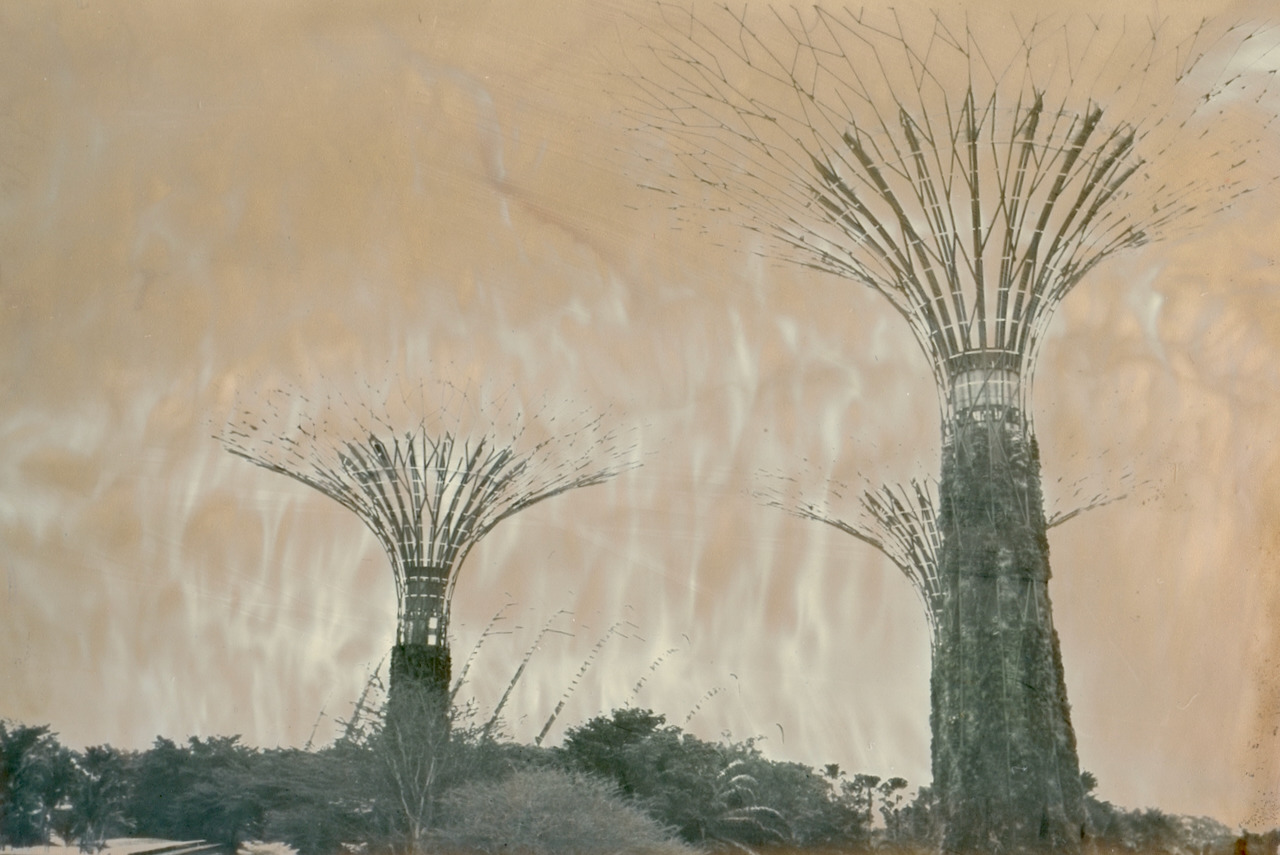
I photographed them with the process already in mind. The workshop at Mörk was only weeks before the trip, and I went to Singapore knowing I had a technique that puts a reflective metal surface on top of a photograph and no idea yet what it was for. The Supertrees answered that on sight: reflective structures that spend all day imitating something organic, photographed by someone carrying a process that makes photographs behave like metal. This is the rare case where I knew what the prints would be before I had the negatives.
The Sky Went Metal
Everything here is direct toning — the sequence in 034 that mirrors the highlights rather than the shadows — on Ilford Satin RC, straight down Lexy Xiao's recipe with no modifications. This is the one part of the project where the chemistry was settled and the pictures could be the point.
Direct toning is the obvious choice for this subject, and the consequence is one I went in wanting. Mirroring the highlights of a photograph taken outdoors in Singapore means mirroring the sky. So the sky is metal. The bright faces of the structures are metal. The blown areas where light came through the canopy are metal. The only parts of the print that behave like a normal photograph are the shadows.
What I could not know in advance was how far it would go. Anticipating a metallic sky and standing in front of one are different experiences, and the prints are considerably more disorientating than the plan for them was.
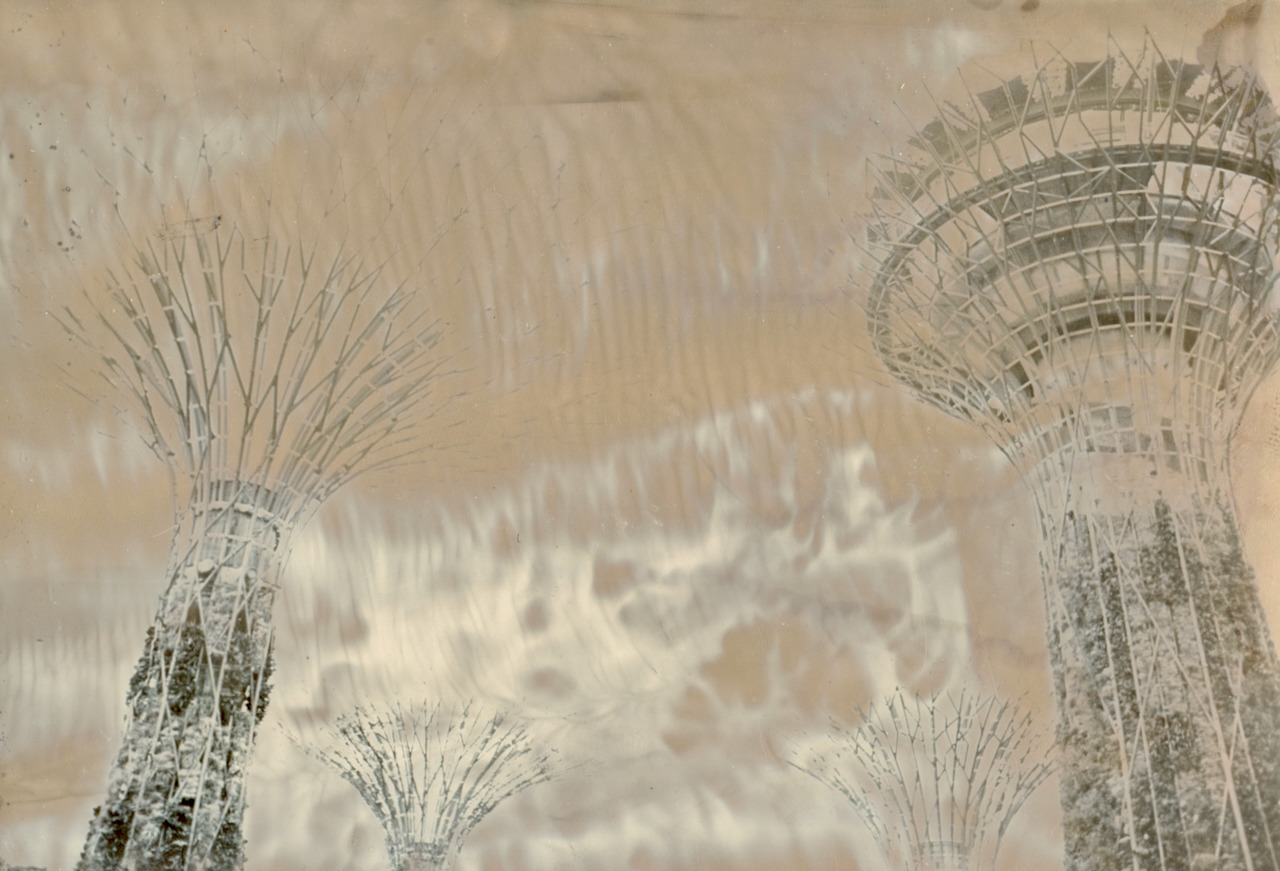
This inverts something basic about how these pictures work. Photographed conventionally, the Supertrees are dark silhouettes against a bright tropical sky — the structure is the subject and the sky is the ground it sits on. Mirrored, the sky becomes the most physically active part of the print, shifting and flaring as you move, while the trees sit still and dark inside it. The subject stops being the thing the picture is of and becomes the only stable place to rest your eye.
I would not have predicted liking that. It works because it is doing the same thing the gardens do. The Supertrees are a reflective armature performing an impression of vegetation; the prints are a reflective armature performing an impression of a photograph. Both only convince from certain angles.
There is a practical consequence to this that took me a while to name. A conventional print holds still while you look at it, and you can therefore compose it as a fixed arrangement of tones. These do not hold still. Move your head thirty centimetres and the tonal relationships in the upper half of the picture invert — sky that read as bright goes dark, or the reverse, depending on where the light is coming from. The composition is not a property of the print; it is a property of the print, the light, and where you happen to be standing. What you can control at the enlarger is the range of pictures a print will produce, not which one a viewer gets.
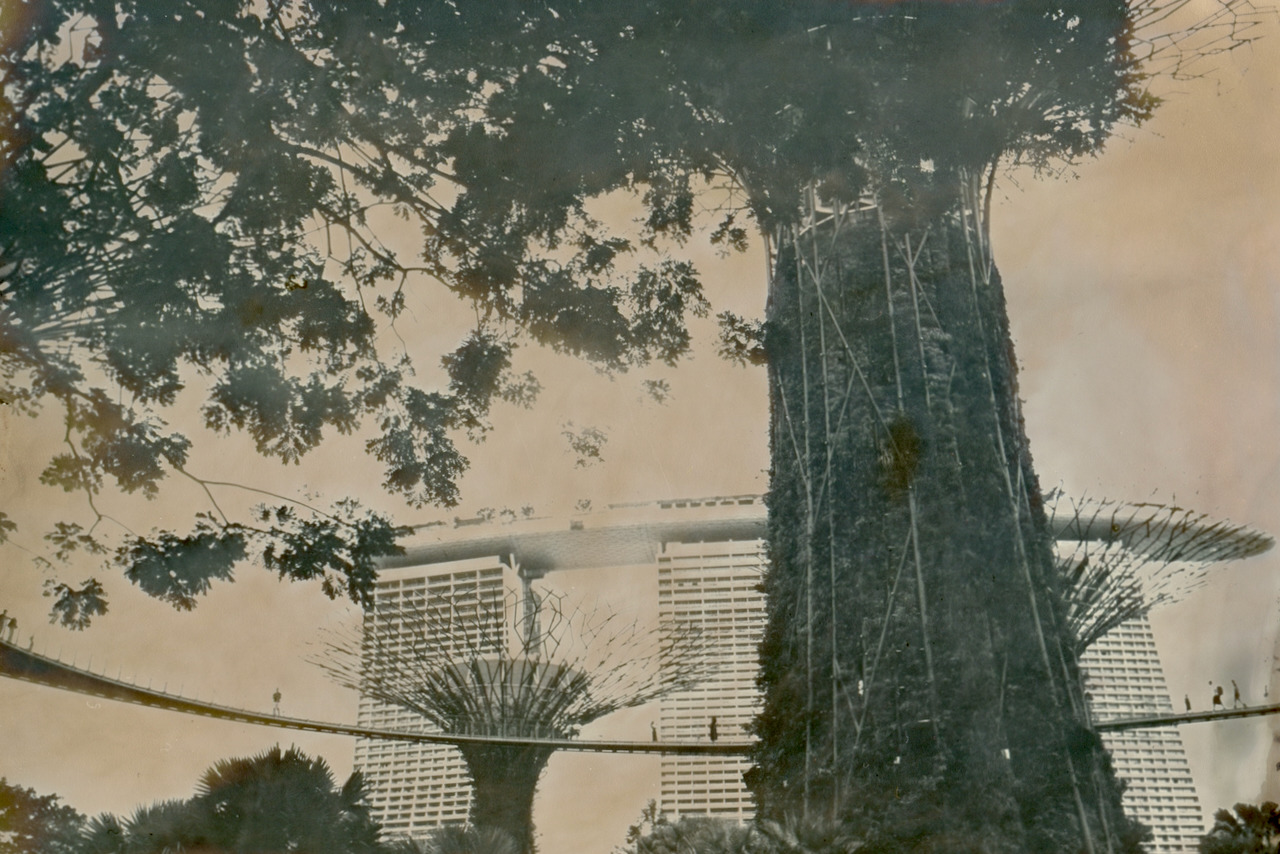
Ilford Satin turned out to matter more than I expected. Satin already sits between matte and gloss, so an unmirrored area has a low, even sheen and a mirrored one reads as a genuine departure from it. On a full gloss paper I suspect the effect would be muddier — the base surface is already doing some of what the toning does, and the two would compete rather than separate.
As a Series
The frames do not all take it equally, and the reason is arithmetic rather than aesthetic. Direct toning acts on the highlights, so the proportion of a print that becomes reflective is roughly the proportion of the frame that was bright — which here means the proportion that was sky. A wide shot of the grove against open sky is mostly mirror. A tighter frame looking up into the planting, where the structure fills the picture and the sky survives only as gaps between the fronds, is mostly a normal photograph with a scatter of bright interruptions.
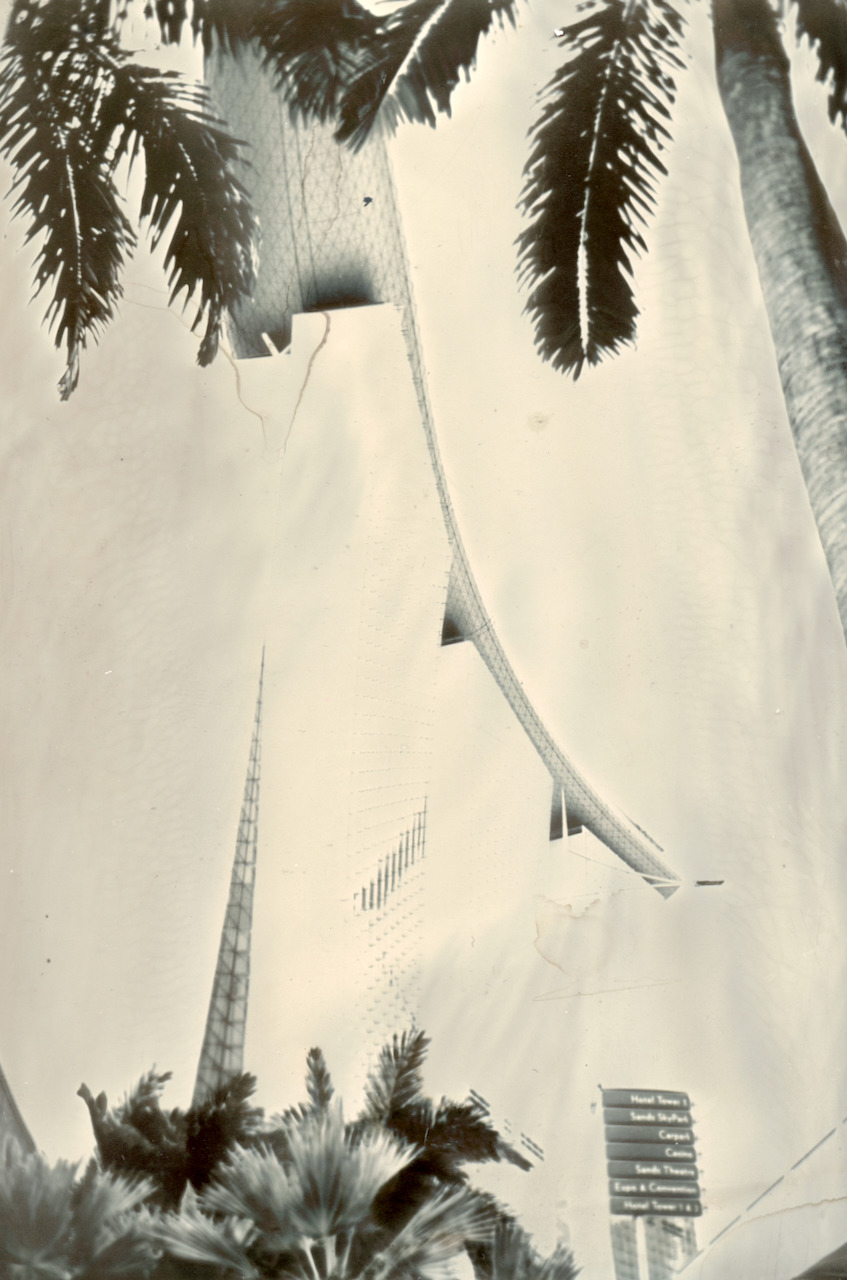
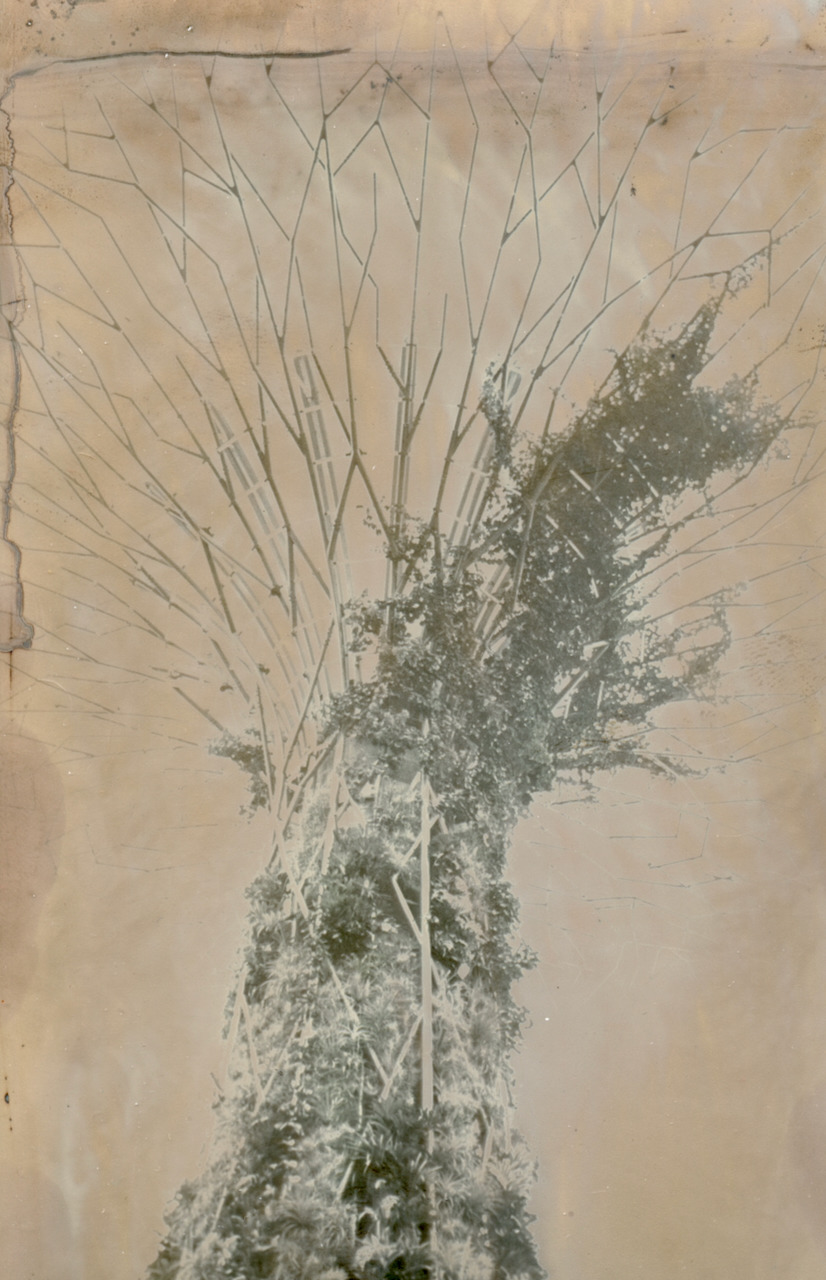
Both are worth having, but they are not the same kind of object, and hanging them together needs some thought. The sky-heavy prints are almost entirely surface; they change completely as you cross the room, and they dominate whatever is next to them. The structure-heavy prints hold still and reward standing closer. Sequenced badly, the first kind eats the second.
What I have not resolved is whether the set wants to be consistent or wants that range. There is a version of this series that picks one density of sky and repeats it, which would give a coherent wall of objects that all behave the same way. There is another that runs deliberately from almost-all-mirror to almost-none, and lets the sequence itself be the subject — the same process shown at every dilution. The second is more interesting and much harder to hang.
Showing Them At All
There is a practical problem sitting underneath all of this, and I do not have it solved.
Almost every distribution channel a photographer uses assumes a flat image. Instagram, a website, a PDF portfolio, the JPEG upload field on an open call — all of them want one file that looks the same to everybody. For these prints, you cannot reproduce these on a digital printer, because the whole effect is a metal deposit rather than a colour that could be matched.
None of which is new. The daguerreotype has had exactly this problem since 1839 — a mirrored plate that flips between positive and negative as you tilt it, and whose every reproduction is a compromise somebody made on your behalf. Institutions never solved that either. What they arrived at instead was a convention: photograph the object at several stated angles, present them together as a set, and say in the caption that the object behaves this way. That is a workable answer, and it reads as accurate description rather than apology. It is roughly what I have done in this post.
The day I started writing this I was at Filmverkstaden in Vaasa and saw a set of Lippmann plates made there in a workshop led by Armands Andže, which put my problem in perspective by being a worse version of it.
Lippmann's process, which won him the Nobel Prize in Physics in 1908, records colour as interference. Light reflects off a mercury mirror in contact with an ultra-fine-grain emulsion, forming standing waves; the emulsion records those waves as layers of silver through its depth; and when you illuminate the finished plate, white light reflecting off those layers interferes constructively at exactly the wavelengths that made them. The colour comes back out. There are no dyes in a Lippmann plate at all.
Which makes it the same family as everything else in this series — structural colour in silver, the 015 argument taken to its logical end. And it is far harder to reproduce than what I am doing. A flat photograph of a mirrored print loses the sheen but keeps the picture. A flat photograph of a Lippmann plate loses the colour, because the colour was never a property of the material — it was a property of the light coming back out of it at a particular angle. Photograph it wrong and you get a grey plate.
The more interesting option is one I have not tried yet. Reflectance Transformation Imaging is a documentation method in which the camera stays fixed and the light is moved to many known positions; software then solves a reflectance function for every pixel, and the output is an interactive viewer in which the reader drags a virtual light across the surface and watches it respond. Not a video of me tilting a print — control handed over.
RTI was developed for cultural heritage documentation, which means the community that built the best available tool for recording angle-dependent surfaces is the same community that classifies silver mirroring as deterioration. They needed to document precisely the phenomenon I am inducing on purpose. The toolchain is open — Relight and RelightLab from CNR-ISTI for processing, OpenLIME as a browser viewer — and capture no longer requires a lighting dome; highlight-based acquisition with a handheld flash and a reflective sphere in the frame is the standard low-budget method, and there is published work on doing it with a phone.
It is worth being precise about what RTI would and would not fix, because the Lippmann plates mark the boundary. RTI holds the camera still and moves the light, so it records how a surface responds to illumination direction. That is most of my problem: the mirroring on these prints depends overwhelmingly on where the light is. It is only part of the Lippmann problem, where the viewing angle matters as much as the lighting angle, and capturing that properly means measuring both — a bidirectional reflectance measurement rather than a one-sided one, which is a considerably larger undertaking. So RTI is probably sufficient for what I make and probably not sufficient for what I saw in Vaasa. Knowing which of those you have is the useful first question.
For open calls in the meantime: most now accept moving-image files, and where they do not, submitting stills together with a plain statement that the work is angle-dependent is ordinary practice for object-based work rather than special pleading.
I should be careful not to overclaim here, though. Resisting reproduction is not a distinction — it is true of every glazed ceramic, every piece of iridescent glass, every daguerreotype, Lippmann plate, what have you. What is worth saying is narrower: the resistance is the same physics the work is made of. A print whose appearance is a report on its surroundings cannot be lifted out of its surroundings and still be the thing.
Closing
The thing that convinced me was watching someone else hold one.
I had been looking at these prints alone, in a flat, under a single lamp, moving my own head to find the angle — which means I had been seeing them the way you see something you made. Then I handed one to somebody who had not seen it before, and watched them do what everybody does: tilt it, catch the light, tilt it back, and then keep going, working the print around in their hands to find where the sky came alive.
What that behaviour shows is not that the picture only exists in motion — the print is perfectly real sitting on the table, and the image is right there in the silver. It is that a reflective surface has no appearance of its own. A matte print carries its tones intrinsically; you can put it in any reasonably lit room and it will look like itself. A mirrored one is always reporting on something else. It needs a light source to be somewhere in particular, and a viewer to be somewhere in particular, and it will give you a different answer for every combination of the two.
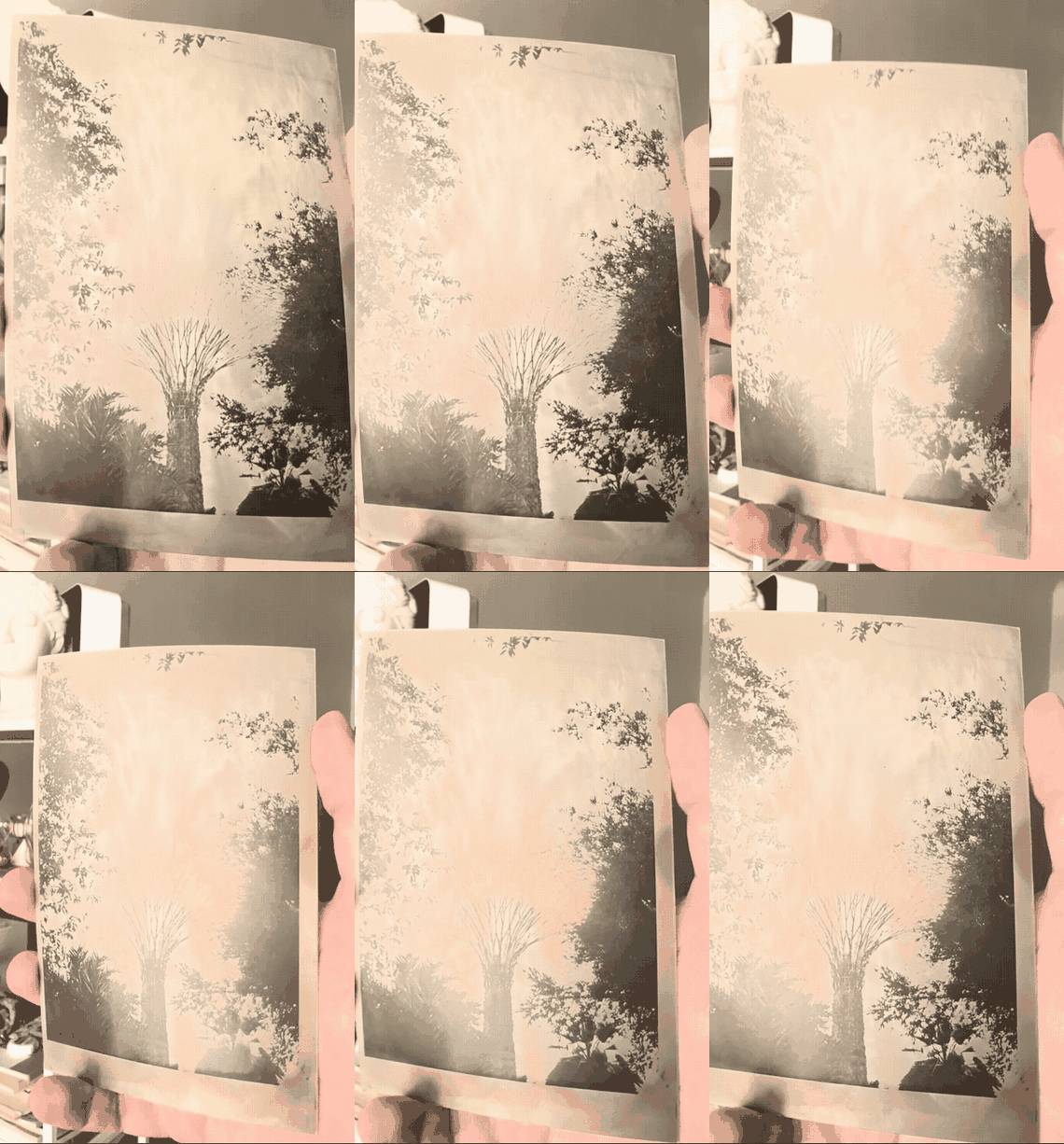
That is not a mystical property. It is what shininess is, and it is the same reason the Supertrees look different at midday than they do lit up after dark. But it does mean I have made an object that cannot be fully specified at the enlarger — the print sets the range, and the room decides the rest. The loop above is the closest this page can come to it, and it is not close.